
More insights.

SUBSCRIBE TO OUR NEWSLETTER.
Where the COLLAB team shares updates on our latest projects, industry milestones, and expert insights into the rapidly evolving creator economy, brand innovation, and cultural trends shaping consumer behaviour.
Let me paint you a picture that every founder in retail knows too well.
You've spent months perfecting a product. You've mortgaged your conviction. You've got a meeting with a major retailer and you walk in with a gorgeous deck, a sample box, and a prayer. The buyer nods politely, says "we'll circle back," and you never hear from them again.
That was retail for decades. Brands begged. Retailers decided. And listing fees made sure only the deep-pocketed survived long enough to find out if anyone actually wanted the product.
In 2026, that script has been completely flipped. And if you haven't noticed, you're already behind.
The New Meeting Looks Very Different
Here's what I'm seeing from where I sit. The founders winning retail distribution right now aren't walking into buyer meetings with mood boards and market projections. They're walking in with dashboards.
A TikTok Shop backend showing 100,000 units shifted in 48 hours. A Shopify analytics suite broken down by postcode, repeat purchase rate, and average order value. That's not a pitch. That's an audit. And suddenly the retailer isn't doing you a favour. They're asking you for the partnership.
The power dynamic has inverted, and the mechanism behind it is what I call the Digital Shelf.
The Digital Shelf: Your R&D Lab, Focus Group, and Proof of Concept in One
When I say "Digital Shelf," I'm not just talking about TikTok Shop, though that's obviously a monster. I'm talking about the entire online commerce ecosystem. Shopify, TikTok Shop, Amazon, your own D2C site. Anywhere a transaction happens with data attached to it.
Here's why that matters. Platforms like these have collapsed the gap between someone discovering your product and buying it. Scroll, see, want, buy. That compression has created something incredibly powerful for brand builders: a live testing environment with real money on the line.
At COLLAB, we use the Digital Shelf to prove product-market fit before we go anywhere near a physical shelf. By the time one of our creator brands lands in a Walmart or a Tesco, we've already calibrated the flavour, the price point, the packaging, and the demand curve. We know which SKUs move. We know which regions over-index. We know the reorder rate.
Social commerce isn't a sales channel. It's the warm-up that guarantees a hot launch in-store.
Retailers Don't Want Products. They Want Pre-Warmed Communities.
This is the bit that legacy CPG brands really struggle with. Creator brands don't just arrive with a product. They arrive with an audience. A community that's been nurtured, sometimes for years, that already trusts the person behind the brand.
Retailers are waking up to this in a serious way. Why would a buyer risk a twelve-month slow burn on an unknown SKU when they could list a creator brand with a built-in fanbase ready to clear shelves on Day One? The creator doesn't just bring distribution demand. They bring a customer acquisition engine that keeps running long after the launch window closes.
That's not influencer marketing. That's infrastructure.

The Proof Is Already on the Shelf
You don't have to take my word for it. Look at what's already happened.
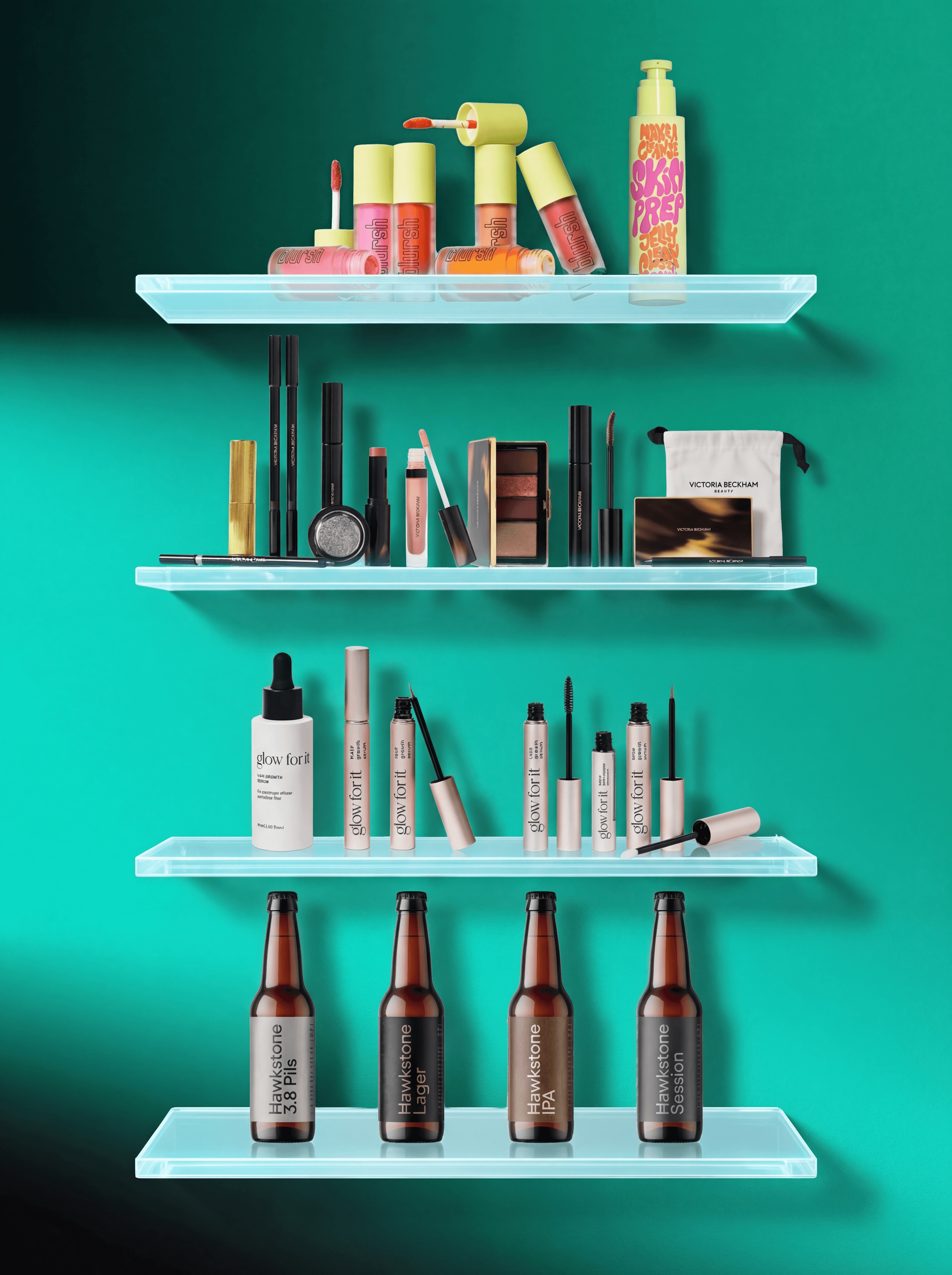
Hawkstone, Jeremy Clarkson's beer brand, launched direct-to-consumer in 2021 on Squarespace, built viral momentum through social channels, migrated to Shopify Plus in 2023, and used that digital traction to roll into physical stockists across the UK. The data led. The retail followed.
Victoria Beckham Beauty took a similar path. Launched as a digital-first luxury brand in 2019, built its commercial credibility through online sales on Shopify, then expanded into select physical retail partnerships from a position of proven demand. Not hopeful speculation.
On the TikTok Shop side, Made by Mitchell is the case study everyone should be studying. Founded in 2020 by makeup artist Mitchell Halliday, MBM became a TikTok Shop phenomenon. The "Blursh" liquid blusher went viral, drove massive transaction volume, and that data trail led directly to a Boots listing. The retailer didn't take a punt. They followed the proof.
And Glow For It, Daisy Kelly's cruelty-free beauty brand born during lockdown, scaled through twelve-hour TikTok Lives and the affiliate programme before converting that digital momentum into physical retail distribution. From bedroom to shelf, powered entirely by commerce data.
Every one of these brands proved demand before asking for permission.
The Handshake: Why We Built Creator Brands Live
This convergence of digital proof meeting physical opportunity is exactly why we built Creator Brands Live (CBL).
CBL is the physical manifestation of this 360-degree ecosystem. We're taking the data-backed successes of the digital world and putting them directly in front of the gatekeepers of the physical world. Retailers, buyers, distributors, in the same room as the creator brands that have already done the hard work of proving demand.
Because "retail" isn't a linear pipeline anymore. It's a loop. The screen drives the shelf, the shelf validates the screen, and the whole thing compounds. CBL is where that handshake happens.
A Word on Trust. Because This Only Works If You Respect It.
I'll finish with the thing I care about most, and the thing most people in this space get dangerously wrong.
A warm audience is only an asset if you don't burn them. Retailers are actively seeking out creators right now because they want that trust, that built-in conversion engine. But the moment you put a lazy product in that community's hands, something that was clearly phoned in to cash a quick cheque, the handshake is broken. And communities don't forget.
At COLLAB, we engineer the product to be as authentic as the person behind it. That's not a tagline. That's the operating model. Because the digital shelf will expose a bad product faster than any retail buyer ever could. The same transparency that gives you power will bury you if you don't respect it.
The brands that win from here aren't the ones with the biggest following. They're the ones that treat their community's trust as the most valuable asset on the balance sheet.
Because it is.
Let me paint you a picture that every founder in retail knows too well.
You've spent months perfecting a product. You've mortgaged your conviction. You've got a meeting with a major retailer and you walk in with a gorgeous deck, a sample box, and a prayer. The buyer nods politely, says "we'll circle back," and you never hear from them again.
That was retail for decades. Brands begged. Retailers decided. And listing fees made sure only the deep-pocketed survived long enough to find out if anyone actually wanted the product.
In 2026, that script has been completely flipped. And if you haven't noticed, you're already behind.
The New Meeting Looks Very Different
Here's what I'm seeing from where I sit. The founders winning retail distribution right now aren't walking into buyer meetings with mood boards and market projections. They're walking in with dashboards.
A TikTok Shop backend showing 100,000 units shifted in 48 hours. A Shopify analytics suite broken down by postcode, repeat purchase rate, and average order value. That's not a pitch. That's an audit. And suddenly the retailer isn't doing you a favour. They're asking you for the partnership.
The power dynamic has inverted, and the mechanism behind it is what I call the Digital Shelf.
The Digital Shelf: Your R&D Lab, Focus Group, and Proof of Concept in One
When I say "Digital Shelf," I'm not just talking about TikTok Shop, though that's obviously a monster. I'm talking about the entire online commerce ecosystem. Shopify, TikTok Shop, Amazon, your own D2C site. Anywhere a transaction happens with data attached to it.
Here's why that matters. Platforms like these have collapsed the gap between someone discovering your product and buying it. Scroll, see, want, buy. That compression has created something incredibly powerful for brand builders: a live testing environment with real money on the line.
At COLLAB, we use the Digital Shelf to prove product-market fit before we go anywhere near a physical shelf. By the time one of our creator brands lands in a Walmart or a Tesco, we've already calibrated the flavour, the price point, the packaging, and the demand curve. We know which SKUs move. We know which regions over-index. We know the reorder rate.
Social commerce isn't a sales channel. It's the warm-up that guarantees a hot launch in-store.
Retailers Don't Want Products. They Want Pre-Warmed Communities.
This is the bit that legacy CPG brands really struggle with. Creator brands don't just arrive with a product. They arrive with an audience. A community that's been nurtured, sometimes for years, that already trusts the person behind the brand.
Retailers are waking up to this in a serious way. Why would a buyer risk a twelve-month slow burn on an unknown SKU when they could list a creator brand with a built-in fanbase ready to clear shelves on Day One? The creator doesn't just bring distribution demand. They bring a customer acquisition engine that keeps running long after the launch window closes.
That's not influencer marketing. That's infrastructure.
The Proof Is Already on the Shelf
You don't have to take my word for it. Look at what's already happened.
Hawkstone, Jeremy Clarkson's beer brand, launched direct-to-consumer in 2021 on Squarespace, built viral momentum through social channels, migrated to Shopify Plus in 2023, and used that digital traction to roll into physical stockists across the UK. The data led. The retail followed.
Victoria Beckham Beauty took a similar path. Launched as a digital-first luxury brand in 2019, built its commercial credibility through online sales on Shopify, then expanded into select physical retail partnerships from a position of proven demand. Not hopeful speculation.
On the TikTok Shop side, Made by Mitchell is the case study everyone should be studying. Founded in 2020 by makeup artist Mitchell Halliday, MBM became a TikTok Shop phenomenon. The "Blursh" liquid blusher went viral, drove massive transaction volume, and that data trail led directly to a Boots listing. The retailer didn't take a punt. They followed the proof.
And Glow For It, Daisy Kelly's cruelty-free beauty brand born during lockdown, scaled through twelve-hour TikTok Lives and the affiliate programme before converting that digital momentum into physical retail distribution. From bedroom to shelf, powered entirely by commerce data.
Every one of these brands proved demand before asking for permission.
The Handshake: Why We Built Creator Brands Live
This convergence of digital proof meeting physical opportunity is exactly why we built Creator Brands Live (CBL).
CBL is the physical manifestation of this 360-degree ecosystem. We're taking the data-backed successes of the digital world and putting them directly in front of the gatekeepers of the physical world. Retailers, buyers, distributors, in the same room as the creator brands that have already done the hard work of proving demand.
Because "retail" isn't a linear pipeline anymore. It's a loop. The screen drives the shelf, the shelf validates the screen, and the whole thing compounds. CBL is where that handshake happens.
A Word on Trust. Because This Only Works If You Respect It.
I'll finish with the thing I care about most, and the thing most people in this space get dangerously wrong.
A warm audience is only an asset if you don't burn them. Retailers are actively seeking out creators right now because they want that trust, that built-in conversion engine. But the moment you put a lazy product in that community's hands, something that was clearly phoned in to cash a quick cheque, the handshake is broken. And communities don't forget.
At COLLAB, we engineer the product to be as authentic as the person behind it. That's not a tagline. That's the operating model. Because the digital shelf will expose a bad product faster than any retail buyer ever could. The same transparency that gives you power will bury you if you don't respect it.
The brands that win from here aren't the ones with the biggest following. They're the ones that treat their community's trust as the most valuable asset on the balance sheet.
Because it is.